Wardogs T-72 tank versus infantry counters, which approach is better and why
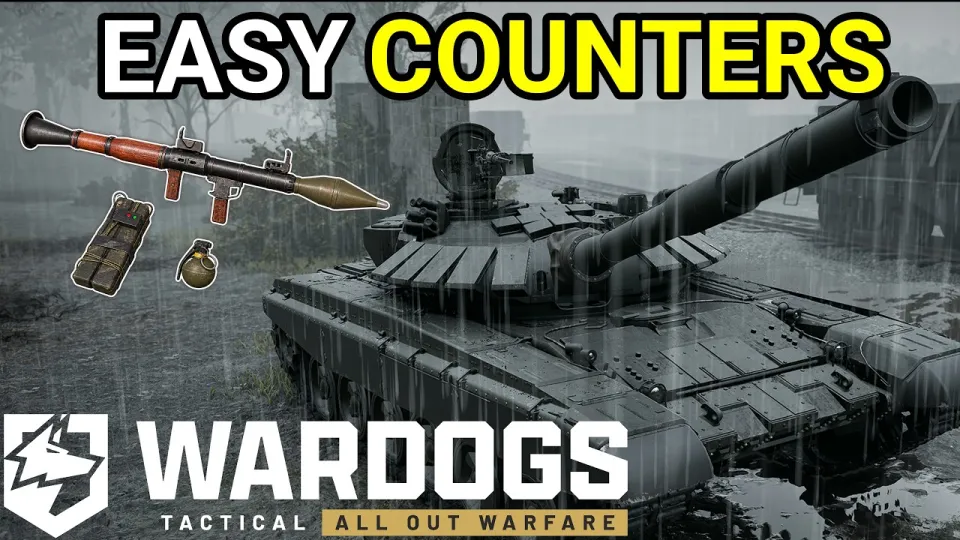
Video: Why Everyone Hates the T-72 Tank in WARDOGS
Want articles like this for your own video to promote it on YouTube and Google? Order them through the Telegram bot @sat_sit_bot. Articles with your video embedded are written and posted by the bot itself — on popular topical sites (no ads). Try it free: 50 articles on us.
The Wardogs T-72 is not unbeatable, but it is unforgiving: it dies to coordinated anti-tank pressure, not to one player with one rocket. Players who call the T-72 overpowered usually attack it alone, from the front, with a single RPG shot, while a supported tank with infantry nearby will survive almost anything a solo player can throw at it.
What actually damages the T-72 in Wardogs
The T-72 has a health pool large enough that a single hit never removes it, so damage has to be stacked. In practice the working tools are:
- Multiple RPG hits landed on the side or rear within a short window, ideally from two shooters so the crew cannot repair between impacts.
- C4 placed directly on the hull by an engineer who reaches the tank unseen — the charge is the reliable kill, not the throw.
- Grenades as a harassment and tracking tool rather than a primary killer; they punish crews that sit still and force the tank to move.
- Armed helicopters and heavy artillery, which outrange the tank and can hit it before it closes distance.
The recurring complaint is that splash and shrapnel sometimes appear to do more work than a direct hit, and that a near-miss RPG can feel more valuable than a clean one. Whether that is a hitbox quirk or a damage-model choice, the practical lesson is the same: one rocket is a poke, three rockets in quick succession is a kill.
Why solo RPG attempts fail against the T-72
A lone RPG gunner loses to the T-72 because the tank sees him first. Third-person camera gives the crew a wide view over walls and around corners, so an infantry player hugging cover is often spotted before he can see the hull at all. Once spotted, the tank reverses or drives off, and a player on foot cannot chase it down.
The failure chain is predictable:
- The gunner fires from the front, where armour is strongest.
- The tank takes the hit, turns, and either kills the gunner with the main gun or leaves.
- The gunner respawns far away and has to re-approach, while the tank repairs.
Grenades partly solve this because they can be thrown from further away than an RPG needs to be aimed accurately, and they do not require a clear line to the hull. Engineers who get close enough for C4 remain the most efficient single-player answer, but only when the crew is distracted.
Teamwork versus armour: how a squad kills a T-72
A squad beats a T-72 by splitting the crew's attention. The pattern that works is simple and repeatable:
- One player fires from the front or side to make the tank turn toward the threat.
- A second player with C4 or an RPG approaches from the opposite flank while the turret is pointed away.
- A third player suppresses any infantry escorting the tank, because escorting infantry is what normally stops step two from working.
Military doctrine says tanks never roll alone, and Wardogs rewards that logic: a T-72 with two or three infantrymen around it is far harder to flank than one parked on a ridge. The counter-argument from the community is that public matches rarely produce that coordination, so a tank supported by a squad dominates while an unsupported one dies quickly. Both observations are true at once, which is why the balance argument never resolves cleanly.
Common complaints about the T-72 and what they get right
Most frustration about the Wardogs tank comes from three places, and each has a real basis.
The unlock timing. Tanks, heavy artillery and attack helicopters are gated behind a points threshold, and armour can appear very early in a match while most players still have basic kits. Players who expected a build-up phase find a T-72 farming infantry in the opening minutes, which is the single most repeated grievance.
The asymmetry of awareness. A tank crew has third-person vision and engine noise that carries roughly 150 metres, so infantry usually hear the tank long before they can do anything about it, while the crew can see the infantry first. Sneaking is possible but unreliable.
The perception gap. Players who drive the T-72 report dying to two fast RPG shots, while players on the receiving end feel the tank soaks everything. The difference is almost always positioning and escort: a tank pushed into open ground without infantry dies; a tank with a screen of riflemen does not.
What the T-72 is actually good and bad at
The T-72 is a long-range pressure tool, not a close-quarters brawler. It excels at holding sightlines, denying roads, and forcing infantry into cover while friendly squads advance. It is weak at reacting to threats that appear inside its turning circle, and it is weakest of all when its crew has no infantry to warn them about a flanker with C4.
The practical rules for crews follow from that:
- Never park where infantry can approach along a wall or trench line unseen.
- Keep at least one escort watching the rear arc.
- Reverse out of contact rather than sitting in smoke and repairing in the open.
- Treat helicopters and artillery as hard counters and break line of sight early.
For infantry, the mirror rules apply: attack the side, attack in pairs, use smoke and buildings to close distance, and accept that a single unsupported attempt is a loss.
Conclusion
The Wardogs T-72 is a strong vehicle that becomes overpowered only when nobody on the other team brings a counter, and the counter is not exotic — two RPG shooters, one engineer with C4, or a helicopter will do it. The real problems are unlock timing that puts armour on the field before infantry tools mature, and a third-person camera that makes flanking harder than it looks. Josephant's breakdown of the T-72 debate is worth watching for the practical detail on what damages the tank and where players go wrong with rockets, C4 and grenades.
Key takeaways
- The T-72 in Wardogs dies to sustained anti-tank fire, not to a single RPG or one C4 charge.
- Third-person view lets tank crews spot infantry sneaking along walls before the infantry can see the tank.
- Grenade shrapnel and splash damage register inconsistently against the T-72's armour model.
- Tanks, heavy artillery and attack helicopters are gated behind the same point threshold, so armour arrives early in a match.
- A lone tank needs nearby infantry to survive; without support it is vulnerable to flanking engineers.
Source: Why Everyone Hates the T-72 Tank in WARDOGS · Markdown version
Questions & answers
Is the T-72 tank in Wardogs overpowered?
It is strong but not invincible. A supported T-72 with infantry nearby is very hard to kill, while an unsupported one dies to two coordinated RPG hits or a single well-placed C4 charge. Most complaints come from solo players attacking it head-on.
What is the best way to destroy a T-72 in Wardogs?
Stack damage fast and from the side or rear. Two RPG gunners firing together, or one engineer placing C4 on the hull while the crew is distracted, works far better than a single rocket. Helicopters and heavy artillery are the ranged answers.
Why does my RPG seem to do less damage than a near miss?
Splash and shrapnel behaviour against the armour model is inconsistent, and many players report that near misses register more effectively than clean hits. Regardless of the cause, the takeaway is to fire several rockets in a short window instead of relying on one.
Why do tanks appear so early in a Wardogs match?
Tanks, heavy artillery and attack helicopters are gated behind a points threshold, and armour can reach the field before most infantry have anti-tank tools. That timing gap, more than the tank's raw stats, drives most of the balance complaints.